
Appreciative Inquiry That Builds on What’s Working
Inspired Engagement applies Appreciative Inquiry to help organizations identify strengths, engage stakeholders, and design change by focusing on what gives life to people, teams, and systems.
Why Appreciative Inquiry Works
Appreciative Inquiry (AI) deliberately shifts the focus of organizational conversation—from problem analysis to possibility exploration.
Rooted in positive psychology, social constructionism, and human systems theory, Appreciative Inquiry builds emotional intelligence and collective ownership by studying moments of excellence, engagement, and success already present in the organization.
Rather than trying to “fix” people, Appreciative Inquiry invites individuals and groups to design the future they want to live into.
This shift in attention changes energy—and energy changes outcomes.
The Appreciative Inquiry 5-D Process
Appreciative Inquiry engagements follow a flexible, cyclical process known as the 5-D Cycle—designed to support shared learning, alignment, and sustained action. Unlike linear change models, the process invites ongoing inquiry as the system evolves.
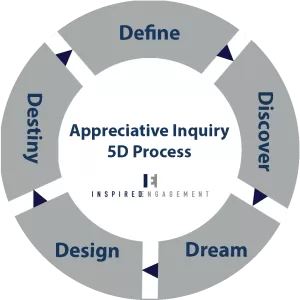
Define – Identify the affirmative focus for the inquiry
Discover – Explore stories of peak experience and success
Dream – Imagine shared possibilities for the future
Design – Co-create structures, priorities, and practices
Destiny – Learn, adapt, and sustain momentum over time
What Appreciative Inquiry Looks Like in Practice
At the heart of Appreciative Inquiry is the appreciative interview—structured conversations where people learn from one another by sharing stories of their best experiences, values, and hopes for the future.
These interviews generate the data that matters most in human systems: lived experience.
Inspired Engagement designs and facilitates Appreciative Inquiry engagements that work in-person, hybrid, or fully virtual, at scales ranging from leadership teams to 250+ participant summits.
Examples include:
Campus-wide planning and governance conversations
Strategic planning and future visioning
Culture and engagement initiatives
Leadership retreats and team resets
Community and stakeholder engagement
Example of Our Work
Gateway Technical College, Kenosha Wisconsin
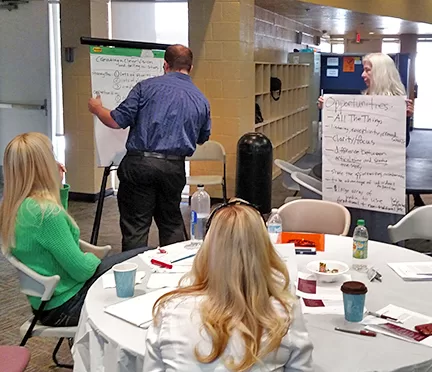
Gateway Technical College partnered with Inspired Engagement to facilitate a large-scale Appreciative Inquiry focused on Excellence in Teaching and Learning. More than 250 faculty members participated in a virtual inquiry that used appreciative interviews, story sharing, and collaborative sense-making to identify when teaching and learning were at their best—and why.
The inquiry generated shared priorities, renewed faculty engagement, and clear momentum for action. One lasting outcome was the creation of the Faculty Teaching and Learning Caucus (FTLC)—the first of its kind at the college—which continues to play an active role in shared governance and academic decision-making.
“This Appreciative Inquiry created space for faculty voices to shape the future of teaching and learning at Gateway—building alignment, energy, and sustained commitment.” – Faculty Participant
Example of Our Work
Gateway Technical College, Kenosha Wisconsin
Excellence in Teaching and Learning: An Appreciative Inquiry
The Situation
Gateway Technical College was advancing its Guided Pathways work and recognized the need to strengthen the fourth pillar, ensuring students are learning. College leaders wanted to engage faculty meaningfully in shaping a shared understanding of excellence in teaching and learning, while avoiding the fatigue and resistance often associated with top-down change initiatives.
The Approach
Inspired Engagement designed and facilitated a large-scale, virtual Appreciative Inquiry involving more than 250 faculty members across the college. Using appreciative interviews, structured story sharing, and collaborative sense-making, faculty explored moments when teaching and learning were at their best and identified the conditions that made those moments possible.
Participants moved from individual stories to shared themes, then into community-of-interest groups using a SOAR framework (Strengths, Opportunities, Aspirations, Results). The process culminated in provocative propositions and strategic intentions, grounded in lived success and owned by the faculty themselves.
The Outcome
The inquiry generated clear priorities, renewed energy, and broad faculty commitment to strengthening teaching and learning at Gateway. One lasting outcome was the creation of the Faculty Teaching and Learning Caucus (FTLC), the first of its kind at the college, which continues to play an active role in shared governance and academic decision-making. The Appreciative Inquiry not only informed strategy; it strengthened trust, engagement, and faculty ownership of the future.
“This Appreciative Inquiry created space for faculty voices to shape the future of teaching and learning at Gateway—building alignment, energy, and sustained commitment.” – Faculty Participant
The Unique Value of Appreciative Inquiry
Appreciative Inquiry builds an organization’s capacity for positive, sustainable change by focusing on strengths, lived success, and shared vision. Rather than diagnosing problems, it creates the conditions for engagement, innovation, and collective momentum—by learning from what works best.
A Positive Core for Change
Appreciative Inquiry builds change by intentionally studying moments of excellence, success, and vitality already present in the system. By focusing on what works, rather than what’s broken, groups uncover their shared strengths and the conditions that enable success, creating a powerful foundation for sustainable change.
The data source is lived success, not problems.
Collective Energy and Ownership
Through structured storytelling and appreciative interviews, Appreciative Inquiry engages people as co-authors of the future. When individuals see their experiences shaping direction and decisions, engagement rises and commitment deepens—because people support what they help create.
Stories, not opinions, drive alignment and momentum.
Forward Momentum Rooted in Shared Vision
Appreciative Inquiry strengthens an organization’s capacity to move forward by helping groups articulate a shared, compelling image of the future. That positive image becomes a pull toward action—guiding decisions, behaviors, and innovation long after the engagement ends.
Change is driven by shared imagination, not compliance.
When Appreciative Inquiry Is the Right Approach
Organizations often turn to Appreciative Inquiry when they sense something isn’t working, but also know that simply “fixing problems” hasn’t led to lasting change. Appreciative Inquiry is most effective when the goal is to build shared understanding, engagement, and forward momentum by learning from what already works.
When You Need Transformational Change
When your organization or team needs to move in a new direction, not by discarding what exists, but by building on strengths, successes, and shared values.
When Engagement or Culture Has Stalled
When morale is low, participation has dropped, or people feel disconnected from purpose — and you want to rebuild energy, trust, and collaboration without blame.
When Leadership Alignment Matters More Than Control
When leaders need clarity, coherence, and shared direction, and recognize that alignment grows through conversation, not compliance.
When Innovation and Strategy Feel Constrained
When problem-focused planning has narrowed thinking and you need to surface hidden assets, creative possibilities, and forward momentum.
When Problem-Solving Has Created Resistance
When repeated focus on what’s wrong has led to defensiveness, fatigue, or disengagement, and a different kind of conversation is needed to move forward.
When any of these feel familiar, Appreciative Inquiry offers a different and more sustainable path forward.
Frequently Asked Questions: Appreciative Inquiry
What exactly is Appreciative Inquiry?
Appreciative Inquiry is a strengths-based approach to organizational change that focuses on learning from moments of success, engagement, and excellence. Rather than diagnosing problems, it helps groups build the future by understanding what works best and how to expand it.
Is Appreciative Inguiry "positive thinking?"
No. Appreciative Inquiry is a research-based methodology grounded in organizational development, positive psychology, and social constructionist theory. It generates real data through structured interviews and collective analysis — data rooted in lived experience, not opinion.
How is Appreciative Inquiry different from problem-solving approaches?
Traditional approaches focus on identifying what’s wrong and fixing it. Appreciative Inquiry focuses on identifying what gives life to a system and building from there. This shift reduces defensiveness, increases engagement, and leads to more sustainable change.
Does Appreciative Inquiry ignore real problems?
Not at all. Appreciative Inquiry acknowledges challenges but approaches them indirectly — by strengthening the conditions that support success. As strengths and alignment grow, many problems lose their grip or resolve more naturally.
When is Appreciative Inquiry most effective?
Appreciative Inquiry works best during moments of transition, planning, cultural renewal, leadership alignment, or when organizations feel stuck in cycles of problem-focused thinking that no longer produce results.
What does an Appreciative Inquiry engagement look like?
Engagements often include appreciative interviews, facilitated group dialogue, shared theme analysis, and co-creation of future priorities or actions. They can be conducted in-person, virtually, or in hybrid formats and scaled from teams to entire organizations.
Can Appreciative Inquiry be combined with other approaches?
Yes. Appreciative Inquiry often complements tools such as CliftonStrengths®, Interest-Based Dialogue, shared governance frameworks, and strategic planning processes by creating a strong foundation of trust, engagement, and shared purpose.
Ready to Build the Future by Learning from What Works?
If your organization is ready to strengthen trust, clarify direction, and engage people in meaningful change, Appreciative Inquiry may be the right starting point.
Prefer email? Contact me directly at scott@inspired-engagement.com
